

Du oder Sie? Tu ou vous ?
Should we address users with the informal or formal version of 'you'?
The challenge
A two-day UX hackathon. A small team of designers, one researcher and one writer carried out a full audit of two NGO volunteering websites that needed to be combined into one. The websites were for organising trips volunteering abroad.
The content was to be rewritten from scratch, in multiple languages. This example focuses only on how to say ‘you’, so users feel comfortable when addressed directly.
The process
I searched online for the German phrase Freiwilligenarbeit im Ausland and the French phrase volontariat à l’étranger, meaning volunteering abroad.
I benchmarked five German and seven French volunteering websites to see which form of ‘you’ they use. Some of the websites were translated into other languages including Spanish.
I also analyzed the homepages of four big-player websites for reference.
My findings were reviewed and supported by native German, French and Spanish test participants who were interested in volunteering abroad.
The results
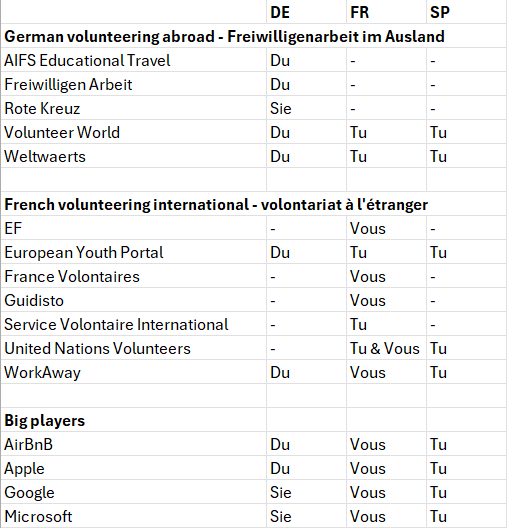
Benchmarking results
German websites
- 4 out of 5 use the informal du.
- 2 have French and Spanish versions, both with informal tu and tu.
French websites
- 4 out of 7 use the formal vous. 1 uses both tu and vous, even on the same page. 2 used tu.
- All German and Spanish versions of the French websites used du and tu.
Big players
- German – it’s a 50:50 split between du and formal Sie.
- French – all 4 websites use vous.
- Spanish – all 4 websites use tu.
Conclusion and proposal for the redesigned website
- German – use du.
- French – use vous.
- Spanish – use tu.